

Once your solar system is interconnected, FPL, Duke Energy Florida, and TECO bill you on the net — the difference between the electricity you pulled from the grid and the electricity your panels sent back. In a month when your home used more than it exported, you pay for the difference at your normal rate. In a month when you exported more than you used, the surplus becomes a kilowatt-hour credit that rolls onto your next bill automatically. Those credits keep accumulating for up to twelve months, and at the end of each calendar year the utility settles up: any credits you never used are paid out at its “as-available energy” rate — a wholesale, fuel-based rate well below the retail price you pay for power. Fixed charges, like the monthly customer charge, stay on your bill no matter how much you generate.
That paragraph is the entire net metering billing system in miniature. The rest of this article walks through it line by line — what the meter measures, how the credit bank works, what the year-end settle-up looks like, and how to sanity-check your first few bills after your system turns on — using the actual Florida Public Service Commission rule, not folklore.
Net metering billing at Florida’s investor-owned utilities is not a courtesy program each company invents for itself. It is required and specified by a Florida Public Service Commission rule: Rule 25-6.065 of the Florida Administrative Code, “Interconnection and Metering of Customer-Owned Renewable Generation.” The rule has been in place since 2002 and its current text has been in effect since 2008. We re-checked that text on the state’s official Administrative Code site the day this article was written; every quoted phrase below comes from the rule itself.
The rule’s own definition is a good place to start, because it says in one sentence what the whole arrangement is for: net metering is “a metering and billing methodology whereby customer-owned renewable generation is allowed to offset the customer’s electricity consumption onsite.” Offset is the operative word. The program’s design center is a home that produces roughly what it uses over a year — not a rooftop power plant selling electricity to the utility.
One boundary to keep in mind: this rule binds Florida’s investor-owned utilities — FPL, Duke Energy Florida, and Tampa Electric. Municipal utilities and rural electric cooperatives write their own programs, and some of them work differently. We come back to that below.
When your interconnection is approved, the utility installs metering equipment — at no additional cost to you, per the rule — “capable of measuring the difference between the electricity supplied to the customer” by the utility “and the electricity generated by the customer” and delivered to the grid. In practice that is a bidirectional digital meter: one register counts kilowatt-hours flowing into your home, another counts kilowatt-hours flowing out of it.
Here is the daily rhythm behind those two numbers. At midday, a well-sized system usually produces more than the house is using; the surplus flows out through the meter to the grid. In the evening, production stops and the house pulls power in. The meter is read monthly, on the same billing cycle you had without solar, and the two registers are compared.
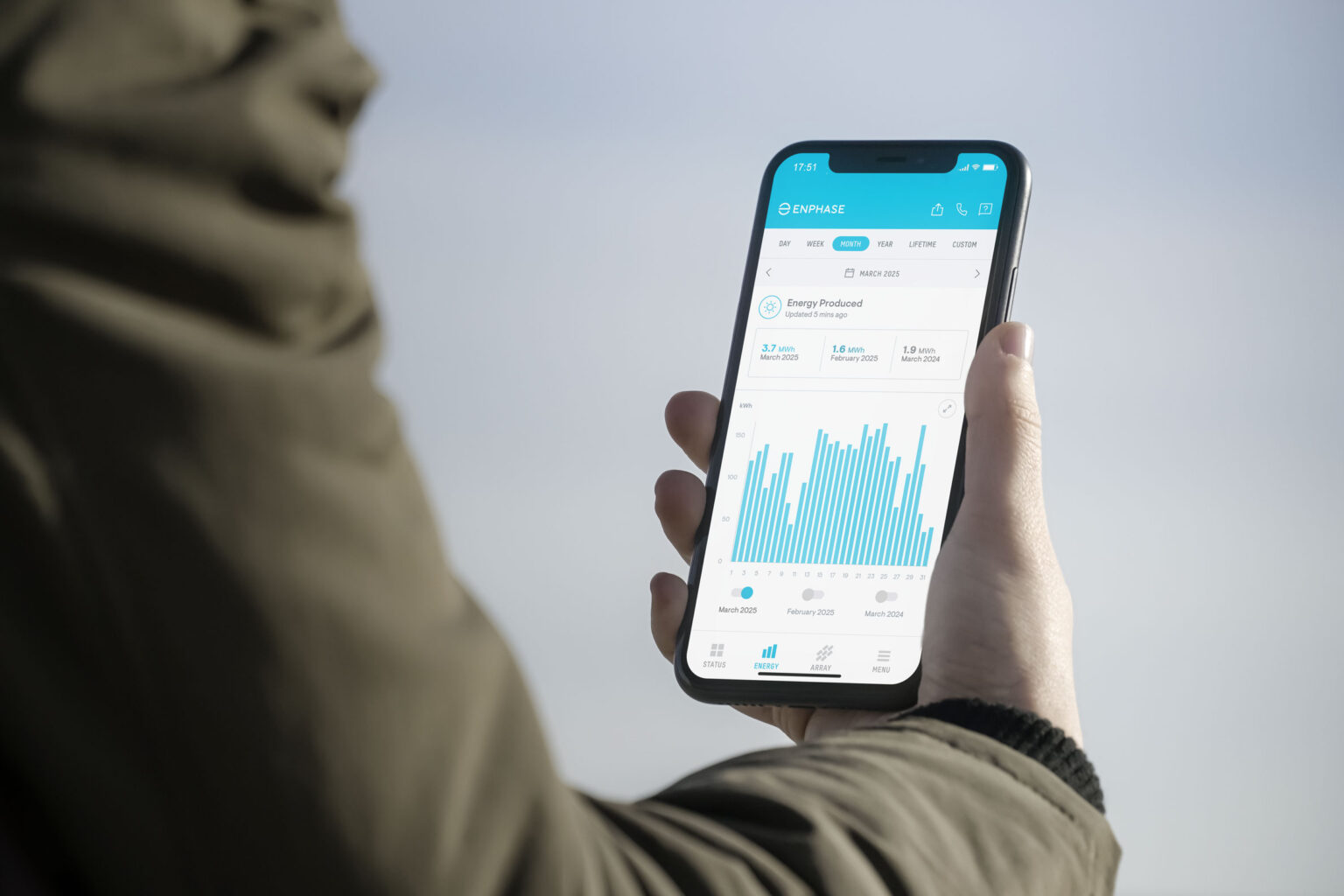
A practical note that saves a lot of confusion: your inverter’s monitoring app and your utility meter are measuring different things. The app reports everything your panels produced, including the energy your home consumed directly without it ever touching the grid. The utility meter only sees what crossed it — imports and exports. Your app’s production number should always be larger than the export number on your bill, often much larger. That is the system working exactly as designed, not a metering error.
Each billing cycle ends in one of two places.
You used more than you exported. The utility charges you for the net difference — in the rule’s words, “for electricity used by the customer in excess of the generation supplied by customer-owned renewable generation in accordance with normal billing practices.” Same rate schedule as before, applied to a much smaller number of kilowatt-hours.
You exported more than you used. Nothing is mailed to you and nothing is forfeited. The rule directs that excess generation “shall be credited to the customer’s energy consumption for the next month’s billing cycle.” The surplus becomes a kilowatt-hour balance that offsets what you draw next month.
On the bill itself, the utilities present this as energy delivered to you and energy received from you, with the net (or the banked credit) carried into the calculation. The line labels differ a little between FPL, Duke, and TECO, but the arithmetic underneath is the same rule.
The rollover is the part of the system built for Florida’s seasons. The rule states that energy credits “shall accumulate and be used to offset the customer’s energy usage in subsequent months for a period of not more than twelve months.”
Why that matters here: Florida homes do not use electricity evenly. Spring and late fall are mild and sunny — production is strong while air-conditioning load is light, so surpluses bank. July and August are the opposite: the AC runs hard, and many solar homes draw down the credits they built up in April and May. A home can run a kilowatt-hour deficit in the peak of summer and still see little or no energy charge, because the spring bank is paying for it.
This is also why judging a solar system by a single bill is misleading in both directions. A big March credit does not mean the system was oversized, and an August bill with an energy charge does not mean it was undersized. The design question is always annual: does production over twelve months line up with consumption over twelve months?
Credits do not roll forward forever. The rule sets a calendar-year settlement: “At the end of each calendar year, the investor-owned utility shall pay the customer for any unused energy credits at an average annual rate based on the investor-owned utility’s COG-1, as-available energy tariff.”
COG-1 is the utility’s tariff for energy it buys on an as-available basis — essentially a wholesale, fuel-driven rate. It is well below the retail rate you pay as a customer, and it moves with fuel costs. The same treatment applies if you close your account and move: unused credits are paid out at that as-available rate.
The design lesson falls straight out of the arithmetic. A banked kilowatt-hour is worth full retail when it offsets your own usage within the year, and only the as-available rate when it is cashed out in the year-end settlement. Overbuilding a system to farm year-end payouts does not pencil; sizing it so annual production tracks annual usage captures the program’s full value. That is why a serious design starts with twelve months of your actual usage history — and why we treat the year-end payout as a rounding item, not a revenue stream, when we model a system.
The rule is equally clear about what keeps getting billed. Regardless of how much energy you export, “the customer shall continue to pay the applicable customer charge” — the fixed monthly amount that covers the meter, the wires, and your connection to the grid — and, on rate schedules that have one, the applicable demand charge. Most residential rates have no demand charge; many commercial rates do, and for businesses that line is a separate design conversation from energy credits.
Taxes, franchise fees, and other pass-throughs on the electricity you actually purchase also remain. The practical upshot: even a month where your credits cover every kilowatt-hour you drew will still produce a bill. It should be a small one — but expecting a literal zero sets you up to think something is broken when nothing is.
All three investor-owned utilities implement the same FPSC rule, and each files its own net metering tariff and standard interconnection agreement with the Commission. The rule sorts systems into three tiers by size — Tier 1 at 10 kW or less, Tier 2 above 10 kW up to 100 kW, and Tier 3 above 100 kW up to 2 MW. Nearly every Florida home lands in Tier 1, which gets the most streamlined interconnection treatment. Where the utilities genuinely differ is in process details — application portals, meter-swap scheduling, in-service timelines — and we keep those current in our utility guides for FPL, Duke Energy Florida, and Tampa Electric.
If your electricity comes from a municipal utility or an electric cooperative, Rule 25-6.065 is not your rulebook. Munis and co-ops set their own solar billing programs, and several credit exported energy at less than the retail rate — JEA in Jacksonville and OUC in Orlando (for newer solar customers) are the prominent examples. The monthly rhythm of the bill looks similar, but the value of an exported kilowatt-hour can be meaningfully different, which changes how a system should be sized. We cover the specifics in our JEA and OUC guides, and the statewide picture — including what is actually changing in Florida net metering and what is not — in our full net metering article.
Your first one or two bills after interconnection are the ones most likely to look strange, usually for boring reasons. A quick checklist:
Does my meter literally run backward? No. The bidirectional meters the utilities install record energy in and energy out on separate registers. The “spinning backward” image is a holdover from old electromechanical meters.
Do I get a check every month for my surplus? No. Monthly surpluses become kilowatt-hour credits that offset your later usage. Money changes hands only at the calendar-year settle-up — or if you close the account — and at the as-available rate, not retail.
Do my credits carry forever? They accumulate and offset usage for up to twelve months, and each calendar year ends with the settle-up described above. Within the year, a banked kilowatt-hour offsets a used one at full value.
I exported more than I used this month — why do I still owe anything? The fixed customer charge and pass-through fees are billed regardless of generation, per the rule. Energy is the only part of the bill your credits touch.
Does adding a battery change the billing? The framework is identical. A battery simply reroutes your surplus: instead of exporting midday production for a credit, you store it and use it that evening. What crosses the meter shrinks in both directions.
Where can I read the actual rule? The full text of Rule 25-6.065 is public and short. For the rest of the Florida-specific questions we hear — permits, insurance, HOAs, batteries — see our Florida Solar FAQ.
A Florida solar bill is not mysterious once you know the four moving parts: the meter nets what you draw against what you send back; monthly surpluses bank as kilowatt-hour credits; the bank settles once a year at a wholesale rate; and fixed charges ride along untouched. Every one of those mechanics comes straight from a public Commission rule you can read in five minutes. If you want to know what those mechanics would mean on your specific bill — your usage history, your utility, your roof — we will run the numbers and walk you through them line by line, including the parts solar will not change.
Get a free, no-pressure solar assessment for your Florida home.

About the author: Joe Cataldo is the CEO of Goldin Solar, LLC, a Vero Beach, Florida–based solar installation company serving homeowners and businesses across the state. He holds a Florida Certified Solar Contractor license (CVC57300) and a Florida Certified Electrical Contractor license (EC13013985), both issued by the Florida Department of Business and Professional Regulation. Joe personally oversees system design standards and code compliance on Goldin Solar projects.