
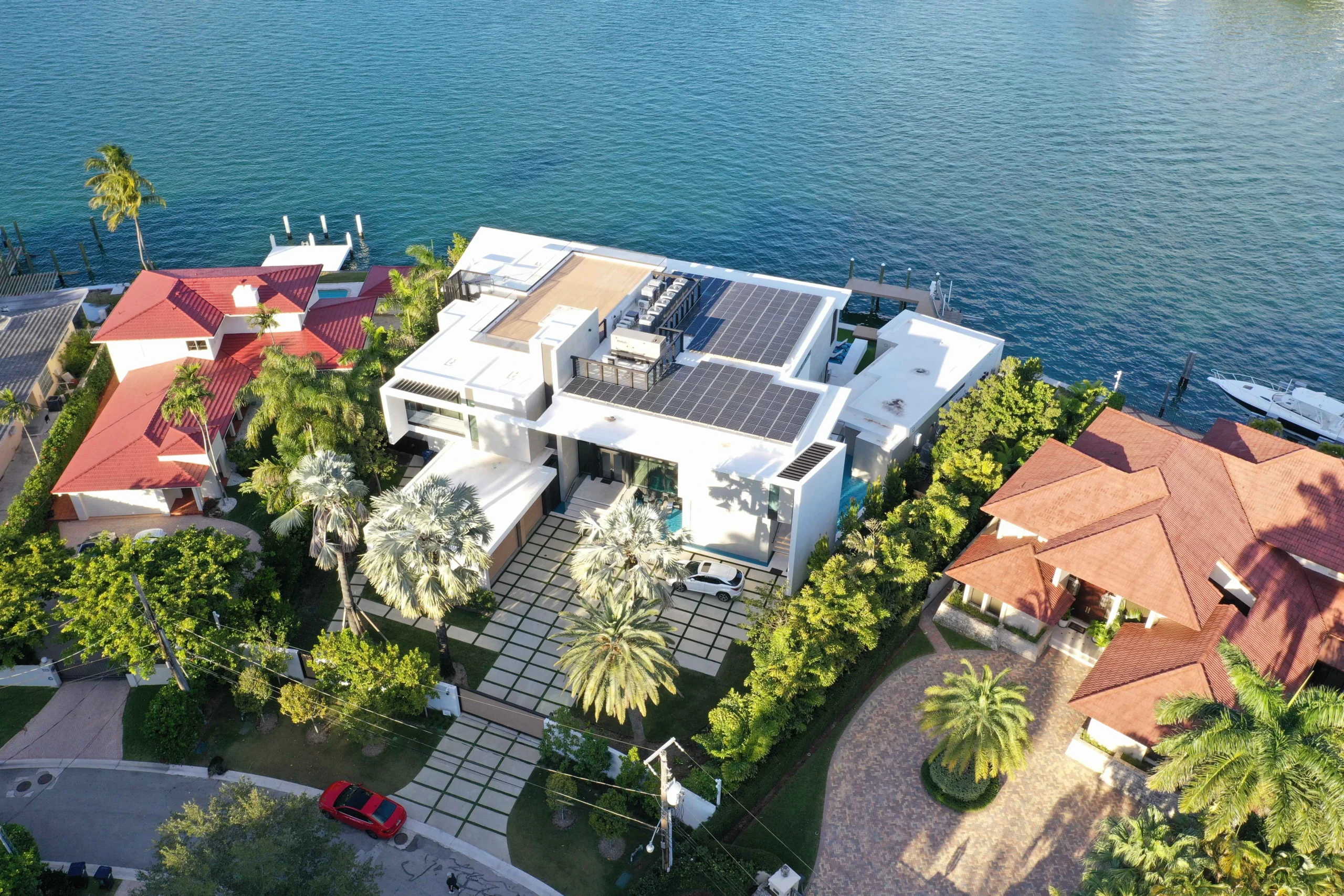
In many Florida homeowners policies, solar panels that are permanently attached to your roof are treated as part of the house itself, so they fall under the same dwelling coverage as your roof and walls. But “many policies” is not “your policy.” Coverage depends on your insurer, your policy form, your dwelling limit, your hurricane deductible, and whether the damage comes from wind, flood, or wear. The single most useful thing you can do is call your insurance agent while you are still planning the system, tell them exactly what you intend to install, and get the answers in writing.
This article explains how solar typically fits into a Florida homeowners policy, where the gaps tend to be, and the specific questions worth asking your insurer. One honest caveat up front: we are a licensed solar contractor, not an insurance agency. We can explain how the pieces usually fit together, but only your insurer can tell you what your policy actually covers.
A standard homeowners policy is built from a few separate coverages, and where your solar equipment lands among them matters.
None of this is automatic. Policy forms differ between insurers, and endorsements or exclusions can change the picture. That is why the conversation with your agent matters more than any general rule.
The most common insurance mistake we see is not a gap in coverage. It is a homeowner who never told the insurer that the house changed. Adding solar increases what it would cost to rebuild your home, and your dwelling limit is supposed to reflect that cost. If the limit was set years ago and you add a solar system and a battery on top of it, the policy may no longer keep up with what you actually own.
Calling early has practical advantages:
Adding solar may or may not change what you pay for coverage. That depends entirely on your insurer and your policy, and only they can tell you.
Bring this list to the call, and ask for the answers in writing or in an email you can keep with your policy documents:
That last question is one homeowners rarely think to ask. When a covered roof claim requires the panels to be detached and reset, that labor is real work for a licensed solar contractor. Whether the policy pays for it is a policy question, so ask.
Florida homeowners policies typically carry a separate hurricane deductible that applies to damage from a named hurricane. It is usually calculated differently from the deductible for other kinds of damage, and on many policies it is considerably larger. That matters for solar: if a hurricane damages a few panels, the cost of the repair may fall entirely within your hurricane deductible, and the insurance pays nothing toward it. Ask your agent how your hurricane deductible is calculated so you know what to expect.
The better protection against storm damage is a well-engineered installation in the first place. Florida’s building code sets wind-load requirements for rooftop equipment, and a properly permitted system is designed and inspected against them. We explain what that looks like in practice in can solar panels survive hurricanes in Florida, and how to get your system and battery ready for storm season in our hurricane-season preparation guide.
Standard homeowners policies generally do not cover flood damage, and that includes damage to solar equipment. Rooftop panels are rarely touched by floodwater, but inverters, batteries, and electrical equipment mounted low on an exterior wall or in a garage can be. If you live in a flood-prone area, ask two questions: does your flood policy — through the National Flood Insurance Program or a private carrier — cover that equipment, and should the equipment be mounted higher? A good installer will raise the second question during design without being asked.
Homeowners often assume that one of these covers everything. They cover different things:
Knowing which of the three applies tells you who to call first. A failed inverter is usually a warranty call; a panel cracked by a falling branch is usually an insurance call. For more on how long the equipment typically lasts in Florida conditions, see how long solar panels last in Florida.

Your homeowners policy is not the only insurance that matters on a solar project. Before work starts, ask the contractor for a certificate of insurance showing general liability coverage and workers’ compensation coverage for the crew. If a worker is injured on your roof or the installation damages your home, you want the contractor’s insurance responding, not yours.
You can also confirm the contractor’s license through the Florida Department of Business and Professional Regulation. Solar installation in Florida is licensed work, and a licensed contractor pulls the permit and has the system inspected by your local building department. That paper trail — permit, inspection, and equipment list — is exactly what insurers tend to ask for. Our article on Florida solar permits explains how that process works.
There is one more insurance-related document most homeowners never notice: the interconnection agreement you sign with your utility to connect your system to the grid. If your power comes from one of Florida’s investor-owned utilities, such as FPL, Duke Energy Florida, or TECO, the Florida Public Service Commission’s interconnection rule for customer-owned renewable generation sorts systems into tiers by size. For the smallest tier, the utility may not require you to carry liability insurance, although the agreement may recommend that you do. For larger tiers, the agreement can require general liability coverage, up to a ceiling set in the rule. Municipal utilities and electric cooperatives set their own interconnection terms. Either way, your utility’s agreement states exactly what applies to your system, and your installer can walk you through it during the interconnection process. If your system is larger than a typical home system, ask about this early.
In Florida, roof age is one of the first things an insurer looks at, and it is also one of the first things a solar designer looks at. Panels typically stay on a roof for decades. If your roof will need replacing in a few years, it is usually smarter to replace it first, both for the solar system and for your insurance. We cover the timing question in detail in roof replacement and solar timing in Florida.
If you already have solar and need a new roof, the panels have to be removed and reinstalled by a licensed solar contractor. Tell your insurer about the roof replacement as well. A new roof can change how they view the policy.
If a storm or a falling tree damages your system, the steps are straightforward:
How a claim is resolved depends on your policy, your deductible, and the adjuster’s findings. No contractor can promise you a particular outcome, and you should be wary of one that does. For the routine checks that help you catch storm damage early, see solar panel maintenance and cleaning in Florida.
Do I need special solar insurance in Florida? Most homeowners do not buy a separate solar policy. Roof-mounted systems are commonly covered as part of the dwelling under a standard homeowners policy. Ask your insurer to confirm that for your policy.
Will my insurance go up if I add solar? It may or may not. Raising your dwelling limit to cover the added equipment can affect what you pay, and insurers price differently. Only your insurer can answer this for your home.
Can an insurer refuse to cover my home because it has solar panels? Insurers set their own underwriting rules, and those rules change. In our experience, roof age and condition tend to matter more than the panels themselves. Ask your agent directly.
Is my home battery covered? Often it is treated as part of the installed system, but naming it on the call removes the guesswork. If you are thinking about adding storage later, see adding a battery to existing solar in Florida, and tell your insurer when you do.
What paperwork should I keep? Keep the permit, the final inspection record, the equipment list with serial numbers, your contract, the warranties, and photos of the finished system. Store copies somewhere other than the house.
For more Florida-specific questions — permits, HOAs, batteries, and storms — see our Florida Solar FAQ.
For most Florida homeowners, insuring a solar system is not complicated, but it does take one deliberate phone call. Roof-mounted panels are commonly treated as part of the house, but the details that matter — your dwelling limit, your hurricane deductible, flood coverage for equipment mounted low, and how your roof’s age plays in — are specific to your policy. Ask your agent the questions above while you are still planning, get the answers in writing, and keep your permit and inspection records where you can find them. If you would like a Florida-licensed team to look at your roof and design a system built to Florida’s wind requirements, with a paper trail your insurer will want to see, we are happy to help.
Get a free, no-pressure solar assessment for your Florida home.

About the author: Joe Cataldo is the CEO of Goldin Solar, LLC, a Vero Beach, Florida–based solar installation company serving homeowners and businesses across the state. He holds a Florida Certified Solar Contractor license (CVC57300) and a Florida Certified Electrical Contractor license (EC13013985), both issued by the Florida Department of Business and Professional Regulation. Joe personally oversees system design standards and code compliance on Goldin Solar projects.